Feb 16, 2018 | Blog, MDC - Post Tsvangirai, Zim Politics
The MDC Constitution 101
By Chipo Dendere
In the wake of Morgan Tsvangirai’s unfortunate death the issue of succession has taken center stage.
Prior to 2016 the MDC power structures matched the constitution with 11 its NSC members directly elected by congress
6.4.3.1 The National Standing Committee
The National Standing Committee shall compose of the president and deputy president and nine others..
(a) The President: Morgan Tsvangirai
(b) The Deputy President: Thokozani Khupe
Under normal circumstances the Deputy President they would refer to section 9.21 of their constitution.
9.21 Death or Resignation of Office Bearers
9.20.1 In the event of the death or resignation of the President, the Deputy President assumes the role of Acting President, pending the holding of an Extra-Ordinary Congress that shall be held to elect a new President which Extra-Ordinary Congress to be held no later than a year from the death or resignation of the former President.
9.21.2 In the event of the death or resignation of the National Chairperson, the Secretary General, the Treasurer General, the National Organizing Secretary the Chairpersons of the Women and Youth Assemblies, their deputies shall respectively hold office until the next Congress.
9.21.3 Subject to this Constitution, in the event of the death or resignation of any other member of the National Council, the same shall elect a person to fill that vacancy pending the next Congress.
Abnormal circumstances
- In July 2016, Morgan Tsvangirai appointed Mudzuri and Chamisa as additional Vice Presidents. In the making of their constitution they did not anticipate that they would add not just one but two deputy presidents. It remains unclear how the party decided that they needed three deputies. Section 4.2. was probably a guard against such abuse of executive privilege.
- Tsvangirai in Article 16 had the power to appoint but not create new positions and certainly not at the executive level. We can also say what was done was done but even with such a position the national council and the president are not above the constitution and the constitution asked that the nominated candidates must be directly elected by congress
- Appointed but not elected
Since the next congress is technically not until 2019 Chamisa and Mudzuri were serving on borrowed time. Ideally, the party should have help an extraordinary congress to elect them and amend the constitution but that did not happen leading to a third issue
- Who is Who in the constitution
In the death of a president the deputy who is duly elected at congress is the only person who has the legal mandate to take over. That said a more ideal situation is one in which the three VPs would have sat down with the rest of the council to vote for an acting president from the three. In rushing an election Chamisa actually used laws that only apply to the ZANU PF or national constitution which recognize the existence of two VPs. The MDC constitution has not yet been amended and there are no clear instructions on how to handle resolutions
- Time frame for National Council meetings: Chamisa did not give his two comrades Khupe and Mudzuri enough time to travel for the meeting. It was very disingenuous to call for a meeting within hours of Morgan Tsvangirai’s death and then to have a vote in less than 24 hours. Their constitution is mum on time frames for important meetings. It is very possible that the vote was not valid.

Feb 12, 2018 | Blog, Zim Politics
Mental Health and our immigrant Experiences
In most black cultures, it is taboo to talk about mental health or mental illness. And yet, many of us remember an aunt or uncle who was a little different or the grandmother who woke up screaming the name of her boy who never came back home. People accept the oddness of the behavior but there are no words in most of our languages to describe the pain of the mind. One can say their head hurts but they can’t express that their mind- the empty space in their mind also hurts. There has been some improvement in how we address and talk about mental health in Zimbabwe. For example, the friendship bench project has created room for people to openly acknowledge their invisible pain.
Since 2000, an estimated two million Zimbabweans left home in response to the declining economic and social conditions. The majority went to South Africa and the United Kingdom. For most Zimbabweans, their trip abroad marked the first time they had left home. A young woman in her early thirties recalled the first time she boarded a flight, “I had just finished A-Level. I was a straight A student. My aunt said I could come to England – work for a few years then go to Uni. I was excited. I didn’t know how to fasten my seat belt. The guy seated next to me on his way back to Australia helped me out”. Interview #1 There are many such stories of young men and women who found themselves headed to a world they knew very little about.
There are many sources of stress among the immigrant community. It is my hope that this essay will contribute to and enrichen a conversation that has already begun in the diaspora community on mental health.
Working to Survive
When I asked people to name five reasons for why they left home the majority identified the failing economy and deteriorating political situation as the two primary push factors. As a result, most Zimbabweans found themselves working 80-hour-minimum wage jobs or in some cases just as many hours for a lower than minimum wage pay. They worked and they sent money. The majority of people I interviewed had never taken a vacation since they emigrated and it was quite common to speak to people who worked 7 days a week. In most cases people started working a day after they arrived in the host country, “I arrived on a Tuesday and my aunt said she had a job ready for me in a care home. I started on Thursday at 6am. Back then people didn’t ask much about papers or even training. Imagine from a nice house in Harare to changing adult diapers” interview #3 in greater London.
Most people shared housing with at least 5 people. A small room that rotated as a bedroom for 5 adults who worked different shifts. “It is not that we could not have afforded to get ourselves a nice apartment but the way things were in Zimbabwe we just wanted to send as much money back home, work a few years, build a house and return” interview #3 unfortunately for most people the few years extended to 5 then 7 then 10 of living in squalid conditions waiting for things to get better back home. The Zimbabwe news coverage always left people in a state of panic and the anxiety filled phone calls from home did not do much to alleviate people’s worry. Access to social media, facebook, whatsapp, Instagram has not only improved family communication but given diaspora better access to the lives of the families left behind.
In extreme cases, the combined stress from money related problems, political fatigue and loneliness sometimes pushed people into illicit work. The majority of Zimbabwean immigrants were educated, urban professionals but not everyone was lucky enough to find work in the host country or had the physical and mental strength for the strenuous work.
“I do not know how it happened. One day a friend suggested that we could do the credit card thing. I had a daughter at home and a kid on the way here and the money seemed easy. I am not proud. I am not proud that I sold out my brothers for time off. I want to start over” interview number #15 Luton
Working long hours sometimes led to fragmented family lives. Most people did not find time to take care of their physical and mental health. A 55 woman who had worked as a lawyer in Zimbabwe found herself overwhelmed by the thought of starting over. Her qualifications were not good enough in the UK, she was an adult student in a class of young students who snickered behind her back, “I had never been bullied before- and here I was being bullied by 18 year olds. They laughed at my accent and made me feel small” interview #45 Scotland- like most diasporas she was balancing school, work and trying to be the perfect African wife who cooked, cleaned and took care of the family every day. It was all ok until, “I woke up in a hospital bed. They said I had collapsed. My blood pressure was very high. The doctors said it was a surprise that I was still alive. I went home and made a schedule- everyone had chores including my husband.” Some families found ways to balance the demands but not everyone was so lucky. The divorce rate among those interviewed was very high and most couples identified work and financial pressures as huge trigger points for divorce. We have also read unfortunate reports of diaspora couple murders.
Loss
In the last 18 years, a lot of Zimbabweans have lost loved ones as a result of the rapidly declining health system, political violence and increasingly, substance abuse. Many of those in the diaspora did not have the opportunity to go home and bury their dead. Mothers have vivid memories of the day they received the phone call informing them of the death of their child and the deep sense of loss when they realized they couldn’t go home.
“I received a call from my now ex-husband that our son was dead. He was only six, just starting grade one. My husband’s mistress was walking him from school, she wasn’t paying attention, he was hit by a hit-run. I was working on my papers, I couldn’t go home.” (Interview #33 in Scotland)
This young mother’s story is one of many that I listened to. I was struck by people’s composure as they shared deeply intimate and sometimes horrific details of their lives. Not a single parent cried during the interviews. As a researcher, I couldn’t cry or ask them to stop. I listened and changed the batteries in my recorder as they talked.
People in the diaspora faced a choice that no one should ever have to make- their livelihood or burying their dead. Attending funerals is therapeutic, saying goodbye is healing and participating in the burial process leads to closure. As people have regularized their status it is now a lot easier to return home for funerals but sometimes others have to choose between helping family back home with the ever-increasing cost of funerals or spending on their flight or bus ride back home.
Loneliness
There is another kind of loss one that we don’t often associate with Africans, with black men in particular, the heavy weight of being alone. On a rare sunny Scotland afternoon, I found myself in a very posh apartment. My subject was an equally posh 30-something year old tech guy. After months of harrowing interviews, I was frankly relieved, I thought the interview was going to be easy. I was wrong. He suggested that we eat at a nice restaurant in downtown Edinburgh, he was twiddling with his phone during the entire meal. I thought it was work. After what felt like hours he put his phone down and said, “no one texted me happy birthday”. It was his birthday and not a single person from home had texted him happy birthday and so he had spent his day “celebrating” with a stranger. I heard the same story over and over of the many lonely celebrations.
It took most of those interviewed an average of five years to reunite with their families. The good news is that since the massive exodus between 2000 and 2008 the average immigrant is likely living in a place with immediate or at least distant relatives. In the United Kingdom people have relocated into cities or towns with other Zimbabweans or Africans and in follow up interviews most people have a church home and community.
I read a sad story a few years back of a young Zimbabwean woman in the diaspora who was dead three days before anyone found her. Her toddler fed herself on juice and snacks all the while watching over her mother’s dead body. There are probably more stories that start out a little differently but end in the same tragic way. In some cases, this is inevitable but it doesn’t have to be like this.
What now?
Leaving home is scary. There is no shame in acknowledging that. Emotional scars are just as important as physical scars and people shouldn’t fear reaching out for help. If you’re reading this –send a text to a loved one. Check in on them. Buy yourself something nice. Find something to make you laugh.
How do I take care of myself mentally and emotionally?
I deal with homesickness and stress by doing yoga, exercising, hanging out with friends and family regularly (even over whatsapp). I plan phone dates with people I know will make me laugh. A good friend, Loice, taught me the importance of investing in myself. She said we should gift ourselves things. Now whenever I buy something for family back home or send remittances I do the same for myself because bitterness is a bitter pill.
When my sister died, I joined a grief counseling group. It was uncomfortable at first –And I have a degree in psychology- but it was helpful to be around people who didn’t need me to explain anything. I never said a word the entire ten sessions but I felt a whole lot better.
Another friend introduced us to the concept of planning our own birthday celebrations. Actively saying to ourselves – Happy birthday ME!
Jan 30, 2018 | Blog, Zim Politics
A conversation on Ufahamu Africa with Kim Dionne: Ep26. A conversation with Dr. Chipo Dendere on the politics of exit in Zimbabwe and beyond
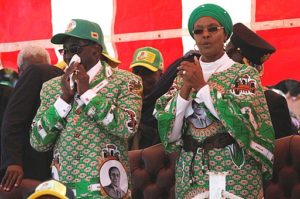
Zimbabwe President Robert Mugabe with First Lady Grace Mugabe, photographed in 2013 in Harare. (DandjkRoberts/Wikimedia Commons)
“In this week’s episode, we speak with Dr. Chipo Dendere (@drDendere), a Consortium for Faculty Diversity Fellow & Visiting Assistant Professor of Political Science at Amherst College. Her research is on the survival of liberation parties and democratization in Africa. We talk about her work on the politics of emigration out of Zimbabwe as well as protest movements, social media, and the role of money in politics. Our conversation begins at 3:55.” You can listen to our conversation here

 Loading...

 Reload document
  Open in new tab
Discussion